
AI Governance Is Not an IT Problem: Why HR Leaders Must Own the Workforce AI Risk Framework
In a multinational manufacturing firm in Germany, a departmental manager deployed an AI-powered workforce scheduling tool to optimise shift allocation based on demand forecasting. The system was designed to balance workload, reduce overtime, and improve employee availability.
From an IT perspective, this was a productivity tool - a straightforward algorithm processing historical data to predict future staffing needs.
From an HR and Employee Relations (ER) perspective, it was something entirely different.
The tool altered working conditions. It introduced new scheduling patterns. It affected employee well-being and work-life balance. More critically, it triggered co-determination rights under §87(1) No. 2, 3 and 6 of the German Works Constitution Act (BetrVG), which require works council involvement when working time arrangements or technical monitoring systems are introduced.
The IT team had not consulted ER. No workforce impact assessment had been conducted. No engagement plan existed.
When the works council raised concerns, the deployment was frozen. Months of retroactive consultation followed. Trust eroded. Subsequent change initiatives became harder.
This pattern is not isolated. It is playing out across Europe, the UK, and North America.
AI is already embedded in workforce decisions. But its governance is often sitting in the wrong place.
Workforce AI governance is not a technical compliance exercise. It is a labour relations issue. It is a consultation issue. It is a legitimacy issue.
And it sits squarely within HR and ER - not IT.
The Structural Flaw in Current AI Governance
Most AI governance frameworks are built by and for technical teams. They focus on:
- Model accuracy
- Bias testing
- Data privacy
- Security controls
- Compliance with GDPR or similar data protection laws
These safeguards are necessary. But they are not sufficient.
They do not address:
- Co-determination rights
- Collective bargaining implications
- Consultation triggers
- Workforce impact documentation
- Ongoing employee representative oversight
The missing layer is workforce governance.
When AI Becomes a Labour Relations Issue
Consider an AI system used to assign client work across teams.
The model evaluates skills, availability, and past performance to optimise allocation.
Technically, this is routine machine learning.
Organisationally, it affects:
- Work intensity
- Exposure to high-stress accounts
- Career visibility
- Performance evaluation inputs
- Team dynamics
If high-volume clients are disproportionately allocated to certain employees, morale shifts. If allocation logic lacks transparency, trust erodes. If consultation obligations are bypassed, disputes emerge.
Under the EU AI Act, AI systems used in employment-related decision-making - including task allocation, recruitment, promotion, and performance evaluation - are classified as “high-risk” systems. This classification imposes enhanced governance, documentation, transparency, and oversight requirements.
In Germany, systems that influence performance monitoring or working conditions may trigger co-determination under §87 BetrVG.
In the UK, consultation obligations may arise under the Information and Consultation of Employees Regulations 2004, collective bargaining arrangements, or trade union frameworks under TULRCA. Additionally, automated decision-making affecting employees may engage UK GDPR fairness and transparency requirements.
The regulatory landscape is evolving. The consultation exposure is real.
The most dangerous AI deployments are not the ones that fail technically. They are the ones that succeed operationally but are later invalidated because consultation was bypassed.
The Hidden Cost of Unmanaged AI Adoption
When AI enters workforce processes without HR governance, organisations create latent consultation risk.
That risk often surfaces only when:
- A works council demands information
- An employee challenges a decision
- A union raises a dispute
- A regulator requests documentation
At that moment, organisations discover they lack:
- Documented impact assessments
- Consultation records
- Clear classification of the AI system
- Governance ownership
- Audit trails
The result is operational delay, reputational damage, and increased resistance to future transformation.
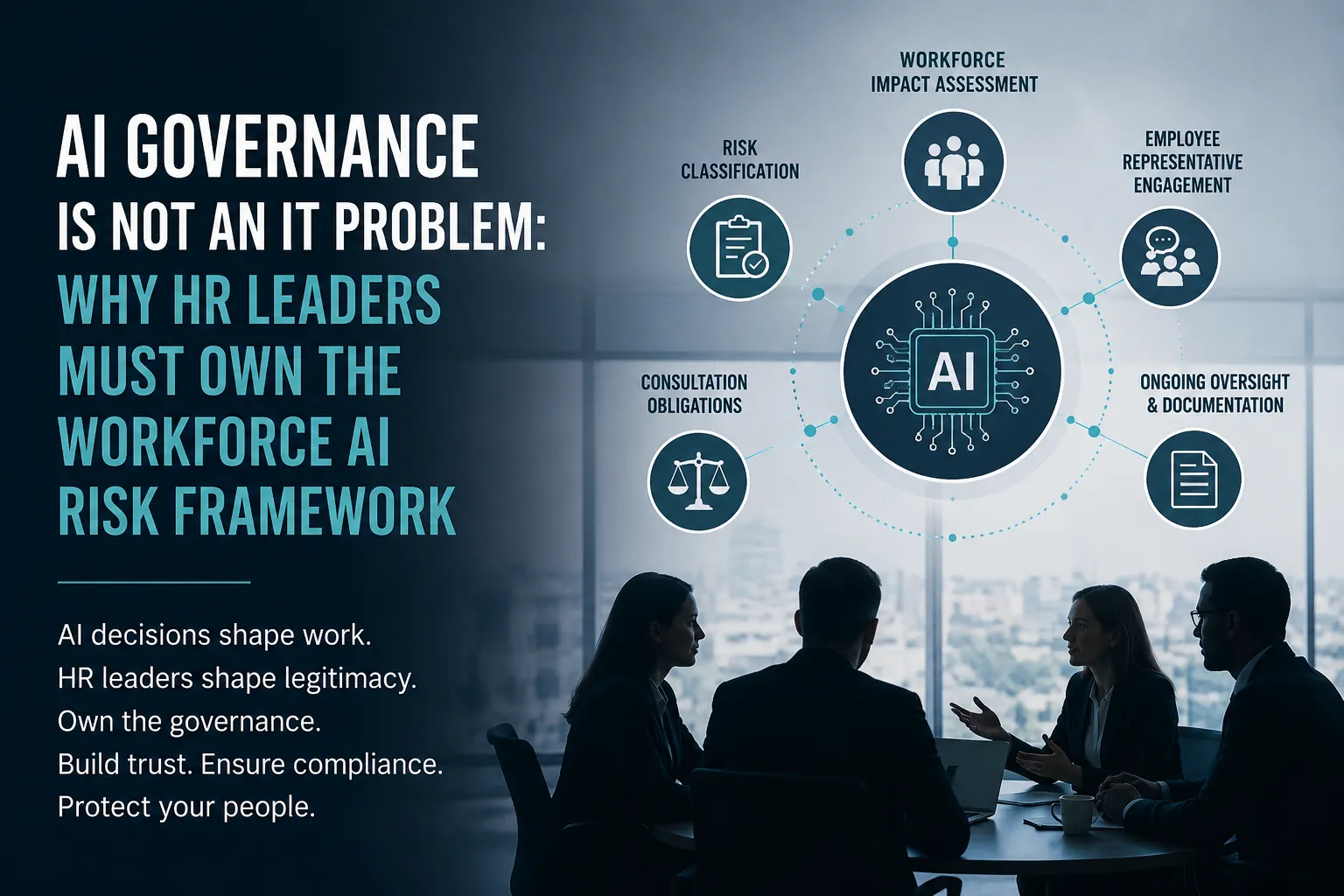
The Workforce AI Risk Framework
To address this gap, HR and ER leaders must implement a structured governance model tailored to workforce impact.
1. Risk Classification
Not all AI systems carry equal workforce risk.
HR must determine:
- Does the system affect employment decisions?
- Does it alter working conditions?
- Does it monitor performance?
- Does it trigger co-determination or consultation rights?
- Does it fall within high-risk employment AI under the EU AI Act?
Without classification, governance becomes reactive rather than structured.
2. Workforce Impact Assessment
Even operational tools can reshape employee experience.
HR should assess:
- Workload distribution changes
- Scheduling patterns
- Career progression effects
- Stress and well-being implications
- Fairness perception
This is not technical bias testing. It is organisational impact analysis.
Documenting this assessment is critical for legal defensibility and representative engagement.
3. Employee Representative Engagement
When AI systems affect working conditions, consultation is not optional.
HR must determine:
- Which jurisdictions are impacted
- Which representative bodies must be engaged
- What information must be disclosed
- At what stage engagement must occur
Consultation cannot be retrofitted after deployment. It must be embedded into the governance workflow.
4. Ongoing Oversight & Documentation
AI governance does not end at go-live.
HR must maintain:
- Usage monitoring
- Outcome review
- Impact tracking
- Documentation updates
- Engagement records
Without ongoing oversight, compliance degrades over time.
Why HR Must Own This
IT teams are accountable for system functionality.
HR and ER teams are accountable for workforce legitimacy.
AI governance in the workplace requires both - but ownership of workforce impact must sit with HR.
Because HR understands:
- Collective agreements
- Consultation thresholds
- Works council dynamics
- Cross-border labour frameworks
- Employee trust implications
Leaving workforce AI governance solely with IT creates blind spots.
Operationalising Workforce AI Governance
This is where structured governance tools become essential.
Graylark provides the operational governance layer that bridges business-led AI initiatives and employee relations compliance.
It enables organisations to:
- Register AI-related change proposals
- Classify workforce risk exposure across jurisdictions
- Identify consultation triggers
- Track representative engagement workflows
- Maintain audit-ready governance documentation
AI adoption will accelerate.
Regulatory scrutiny will increase.
Works council expectations will expand.
The organisations that succeed will not be those with the most sophisticated algorithms - but those with the most disciplined workforce governance.
AI governance in the workplace is not an IT problem.
It is a workforce governance challenge.
And HR and Employee Relations leaders must own the framework that ensures AI is deployed not only efficiently - but legitimately, lawfully, and sustainably.