
Why Global Restructurings Often Take Longer Than Planned
Most global restructuring programmes do not fall behind because the strategy is wrong.
The business case may be approved. The target implementation date may be agreed. The transformation roadmap may be signed off.
Yet months later, the programme is behind schedule, key milestones have slipped and implementation remains uncertain.
Often, the problem is not the plan itself. It is that the programme timeline and the consultation timeline were never the same thing.
Corporate teams usually build restructuring programmes around a single business case, a single implementation plan and a single target date. But implementation rarely happens as a single event. It happens country by country, each with its own consultation obligations, employee representative structures, legal requirements and local sensitivities.
That gap between corporate planning and country-level consultation reality is one of the most common reasons global restructuring programmes take longer than expected.
It is not always a lack of planning. It is not necessarily a shortage of resources. More often, it is a governance issue: the organisation is trying to deliver one global programme through multiple local processes that do not move at the same speed.
The hidden complexity behind a single programme
When a restructuring programme is designed at headquarters, it is usually built around a single timeline.
The programme sponsor wants certainty. The business wants to realise benefits quickly. Finance wants to understand when savings will land. Communications teams want a coordinated message. On paper, the plan can look straightforward.
In practice, implementation may depend on multiple consultation processes across different jurisdictions. Each country may have different rules on when consultation must begin, who must be involved, what information must be provided, how long the process may take and what approvals or agreements may be required before implementation can proceed.
What appears to be one programme is often a collection of interconnected local processes, each moving at a different pace.
A restructuring affecting employees in Germany, France, Spain, the Netherlands and Poland, for example, may look like a single transformation programme at corporate level. At country level, it quickly becomes something more complex.
Germany may involve works council negotiations through an Interessenausgleich and Sozialplan process. France may require formal consultation with the CSE, potentially supported by external experts. Spain may require a structured ERE process involving negotiations with employee representatives. The Netherlands may introduce approval or procedural requirements before certain dismissals can proceed. Poland may require consultation, notification or collective redundancy steps depending on the scale and nature of the change.
These are not minor variations of the same process. They are different legal and employee relations frameworks that have to be coordinated within one broader transformation programme.
The challenge is not simply managing consultation. It is managing several consultation processes at once while maintaining visibility, consistency and momentum across the programme as a whole.
This is where restructuring timelines often begin to drift. Country-level dependencies are not always visible in the original business case. Consultation milestones may not be integrated into the programme plan. Local risks may sit outside central reporting. By the time the issue becomes visible, the target implementation date may already be under pressure.
Where restructuring plans start to go wrong
One common failure point is the desire for a coordinated global announcement.
The intention is understandable. Corporate communications teams want consistency. Leaders want employees to hear a clear message. The business wants to avoid uncertainty.
But in many jurisdictions, announcing a restructuring before consultation obligations have been properly considered or satisfied can create legal, employee relations and reputational risks.
Consultation is not simply a communication exercise. It is a legal and procedural process. In some countries, employee representatives must be informed and consulted before decisions are finalised or communicated more widely. Treating consultation as something that follows an announcement, rather than something that shapes what can be announced and when, can create avoidable delays and challenges.
Another common assumption is that all countries can simply be consulted at the same time.
Sometimes they can. Often they cannot.
Some consultation processes include mandatory sequencing requirements. Others involve formal review periods, expert involvement, negotiation steps, regulatory approval or specific documentation obligations. Some countries may be able to move quickly. Others may require more time before implementation can lawfully begin.
This does not mean global restructuring programmes cannot be coordinated. They can. But coordination requires a realistic understanding of which activities can run in parallel, which must happen in sequence and which dependencies could affect the critical path.
Without that understanding, programme reporting can create a false sense of confidence. A country may appear to be “in progress” when, in reality, a key consultation dependency has not yet been resolved. A milestone may appear achievable until one jurisdiction introduces a delay that affects the wider implementation plan.
The issue is not just delay. It is the lack of early visibility into the causes of delay.
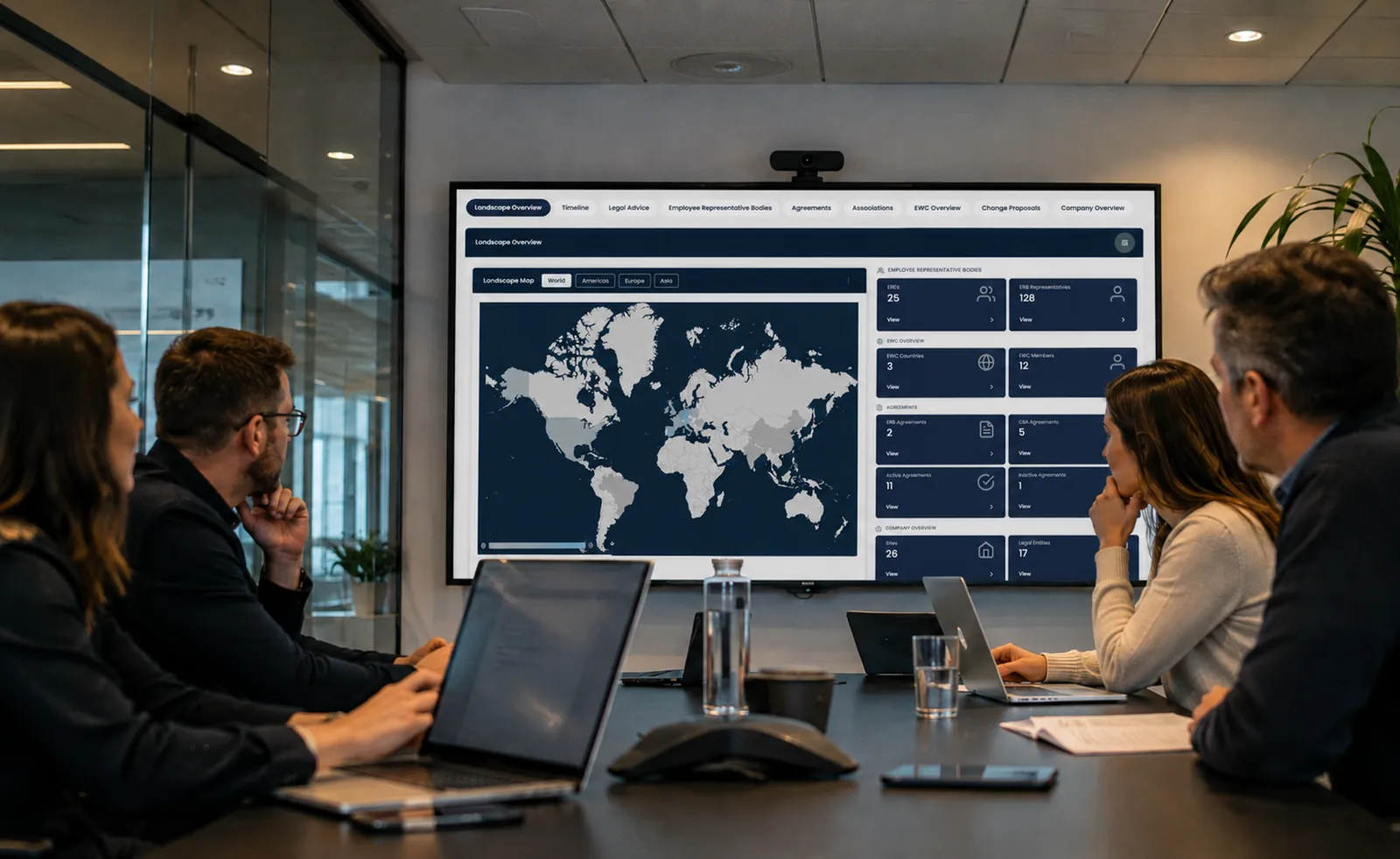
In many organisations, consultation activity remains largely invisible at programme level. Local teams manage their own processes. Documents are stored separately. Updates are shared through meetings, emails and spreadsheets. Risks are discussed locally before they are escalated centrally.
As a result, programme sponsors can struggle to answer basic questions:
Which consultations are complete? Which countries represent the greatest implementation risk? Which approvals or agreements remain outstanding? Is the target implementation date still realistic?
When these questions cannot be answered quickly, the organisation is not really governing the restructuring programme. It is relying on fragmented updates from multiple local processes and hoping they remain aligned.
Restructuring is now a governance challenge
Global restructurings have always been complex, but the environment in which they take place has become more demanding.
Employee consultation expectations are increasing. Works councils and employee representative bodies are playing a more active role in organisational change. Documentation requirements are expanding. Regulators are placing greater emphasis on transparency, accountability and proper process.
At the same time, organisations are introducing AI technologies, centralising operations, redesigning functions and changing workforce structures at pace. Consultation is no longer limited to traditional headcount reduction exercises. Increasingly, organisations must manage the workforce impact of technology, operating model and process changes across multiple jurisdictions.
That creates a different kind of challenge.
Many organisations still approach restructuring primarily as a project management exercise: define the scope, agree the timeline, allocate workstreams, track milestones and report progress.
Those disciplines remain important. But they are not enough.
The harder challenge is governing change across countries where implementation depends on consultation obligations, local legal advice, employee representative engagement and evidence that the right steps have been followed.
Corporate programme teams are usually focused on strategic outcomes. Local Employee Relations teams are focused on legal obligations, consultation requirements and employee representative dynamics. Both perspectives are essential. Problems arise when they operate separately.
One side is trying to accelerate change. The other is trying to manage risk. Without a shared governance framework, those two activities can begin to move independently.
That is when consultation milestones drift away from programme milestones. Local risks become disconnected from central reporting. Implementation dates are agreed before readiness is properly understood. The programme continues to move, but not always in a way that reflects what is actually happening on the ground.
This is why restructuring governance increasingly requires more than spreadsheets, email updates and local status calls. Organisations need a structured way to track consultation milestones, dependencies, risks, documentation and implementation readiness across countries.
The aim is not to slow the business down. It is to give the business a more realistic view of what is possible, where the risks sit and what needs to happen before implementation can proceed.
Towards a governed restructuring model
Leading organisations are beginning to treat consultation as a core programme workstream, not an administrative activity that sits outside the main transformation plan.
That means integrating consultation governance directly into the way restructuring programmes are planned, monitored and delivered.
A governed restructuring model usually includes:
- central visibility across jurisdictions;
- country-specific consultation milestones;
- dependency tracking;
- clear escalation routes;
- risk identification and management;
- consistent documentation;
- evidence and auditability.
This gives programme sponsors a more accurate view of implementation readiness. It also helps local Employee Relations, HR and legal teams manage their obligations in a more structured and consistent way.
The role of Employee Relations is changing as a result.
ER teams are no longer simply supporting restructuring programmes once decisions have been made. In complex multinational organisations, they are becoming central to whether transformation can actually be delivered.
Their role is not only to help ensure compliance. It is to help the organisation understand how change can be implemented responsibly, lawfully and with proper visibility across all affected countries.
The organisations that struggle most with global restructuring are rarely those with the weakest strategy. More often, they are the ones with the least visibility into consultation risk.
Global restructurings do not stall because organisations lack ambition. They stall because consultation realities are disconnected from programme governance.
The organisations that navigate change most effectively are not necessarily those that move fastest. They are the ones that align corporate objectives with country-level realities from the beginning.
Successful transformation is not simply about achieving business outcomes. It is about doing so in a way that is legally compliant, operationally coordinated and trusted by the people affected by change.
For organisations managing complex workforce change across multiple countries, the challenge is not only knowing what needs to happen. It is maintaining visibility over consultation milestones, local dependencies, risks and implementation readiness as the programme moves forward.
The Graylark Platform is designed to help Employee Relations, HR and legal teams bring that structure to global change programmes, giving organisations a clearer way to govern consultation activity across jurisdictions and support more confident, compliant transformation.