
The EWC Recast Directive: what employers must do, and by when
The revised European Works Council Directive, Directive (EU) 2025/2450, adopted 26 November 2025, is the biggest change to transnational information and consultation since 2009. It tightens how EWCs must be informed and consulted, ends long-standing exemptions, and backs the rules with dissuasive penalties. Member states must transpose it by 1 January 2028.
This page is the employer’s working reference: what changed, the dates that matter, and a country-by-country tracker of national implementation. Last updated 28 August 2026. The tracker is reviewed monthly.
Key dates for every employer
- 26 November 2025: Directive adopted
- 11 December 2025: Published in the Official Journal (OJ L 2025/2450)
- 31 December 2025: In force
- 1 January 2028: Member-state transposition deadline
- 2 January 2028: Removal of the pre-1996 (“Article 14”) exemptions takes effect
- 2 January 2029: Remaining provisions apply
What changes: the employer’s view
The pre-1996 exemptions end
Companies relying on voluntary “Article 14” agreements that predate the original directive lose that carve-out from 2 January 2028. Negotiating a compliant replacement through a special negotiating body routinely takes 18 to 36 months. The clock is effectively already running.
“Transnational matters” gets broader
More decisions will qualify as transnational, including matters that concern one country but can reasonably be expected to affect workers in others, pulling more change programmes into EWC information and consultation.
Reasoned responses become mandatory
Management must respond to EWC opinions in writing, with reasons, before implementing the decision. “We noted the opinion” no longer suffices. The exchange must be documented and defensible.
Employers fund experts and training
The EWC’s experts, including legal costs, and representative training are funded by the employer.
Real penalties
Member states must provide effective, dissuasive and proportionate penalties; several are expected to link fines to turnover. National choices are what the tracker below follows.
Gender balance and functioning improvements
Gender-balance objectives for SNBs and EWCs, plus tightened rules on confidentiality and on when consultation must happen relative to the decision.
Transposition tracker: country by country
Status of national implementation of Directive (EU) 2025/2450, last reviewed 28 August 2026. We update this monthly; corrections are welcome.
Netherlands: draft bill; consultation closed
An implementation bill amending the WEOR went through public consultation from 18 June to 7 August 2026. It is pure implementation with no gold-plating, and enforcement runs through the Enterprise Chamber rather than fines.
Ireland: commitment stated, no bill yet
The Government confirmed in a Dáil answer of 29 January 2026 that it fully intends to meet the 1 January 2028 deadline. A major revision of the Transnational Information and Consultation of Employees Act 1996 is expected, and a Commission infringement case on the 2009 directive remains open.
Germany and France: no public action found
In Germany no Referentenentwurf has been published and BMAS lists no pending EBRG amendment; in France no projet de loi has been identified. Commentary expects movement during 2026 to 2027.
All other member states: nothing published yet
This is normal about eighteen months before the deadline. Most transposition activity lands in 2027. At EU level, Commission Expert Group E03694 on implementation of the directive met in February and April 2026 and continues through the transposition window.
What to do now
Map your exposure and the agreements the recast touches. Audit whether you could evidence, today, when the EWC was informed, what it was given, its opinion and your reasoned response for your last three transnational changes. Start agreement work early if you rely on a pre-1996 arrangement. Budget for experts, legal costs, training and translation. And put the operational record in one system. The recast assumes documentation discipline that spreadsheets and inboxes don’t produce.
Recast-ready with Graylark LRM
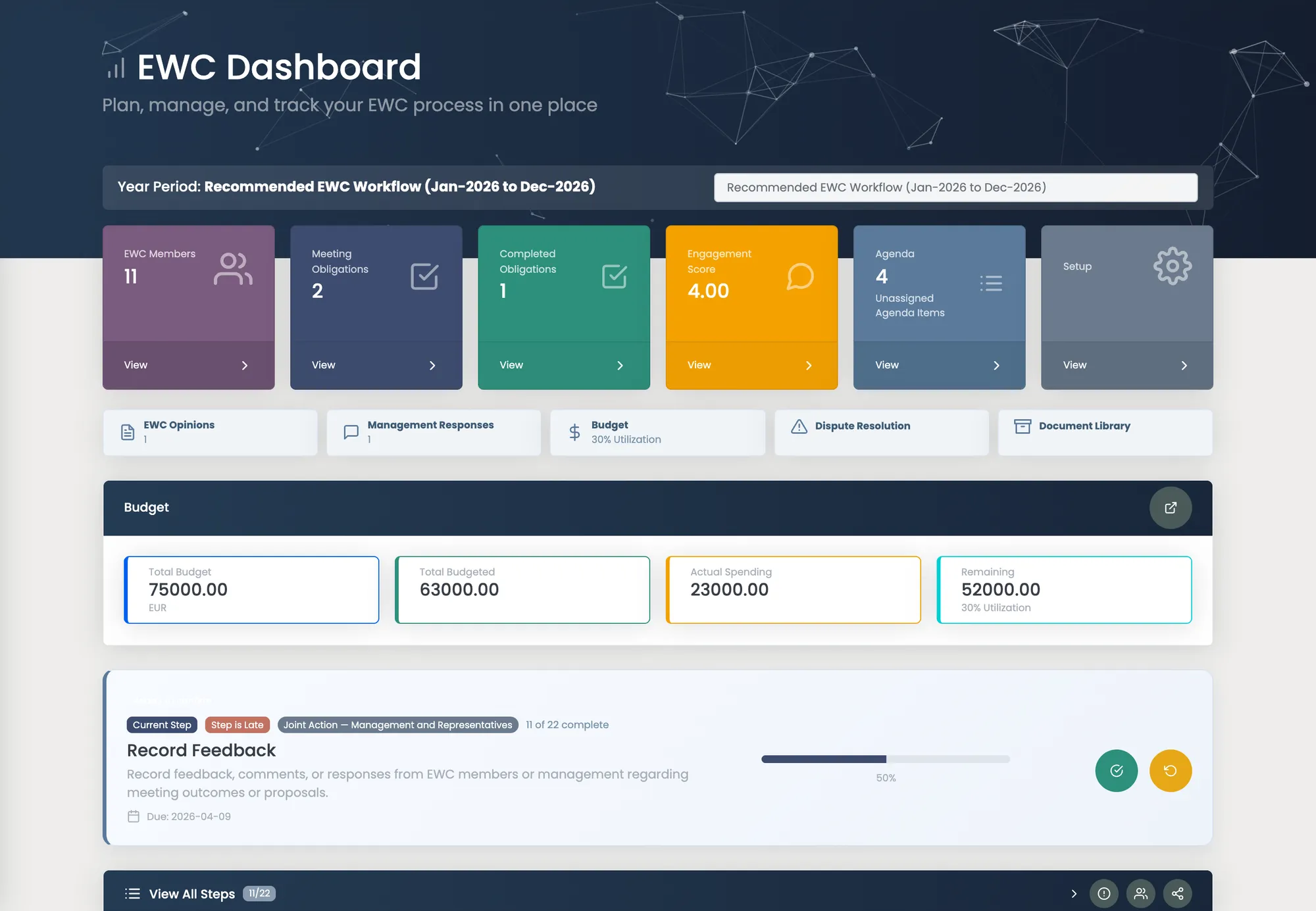
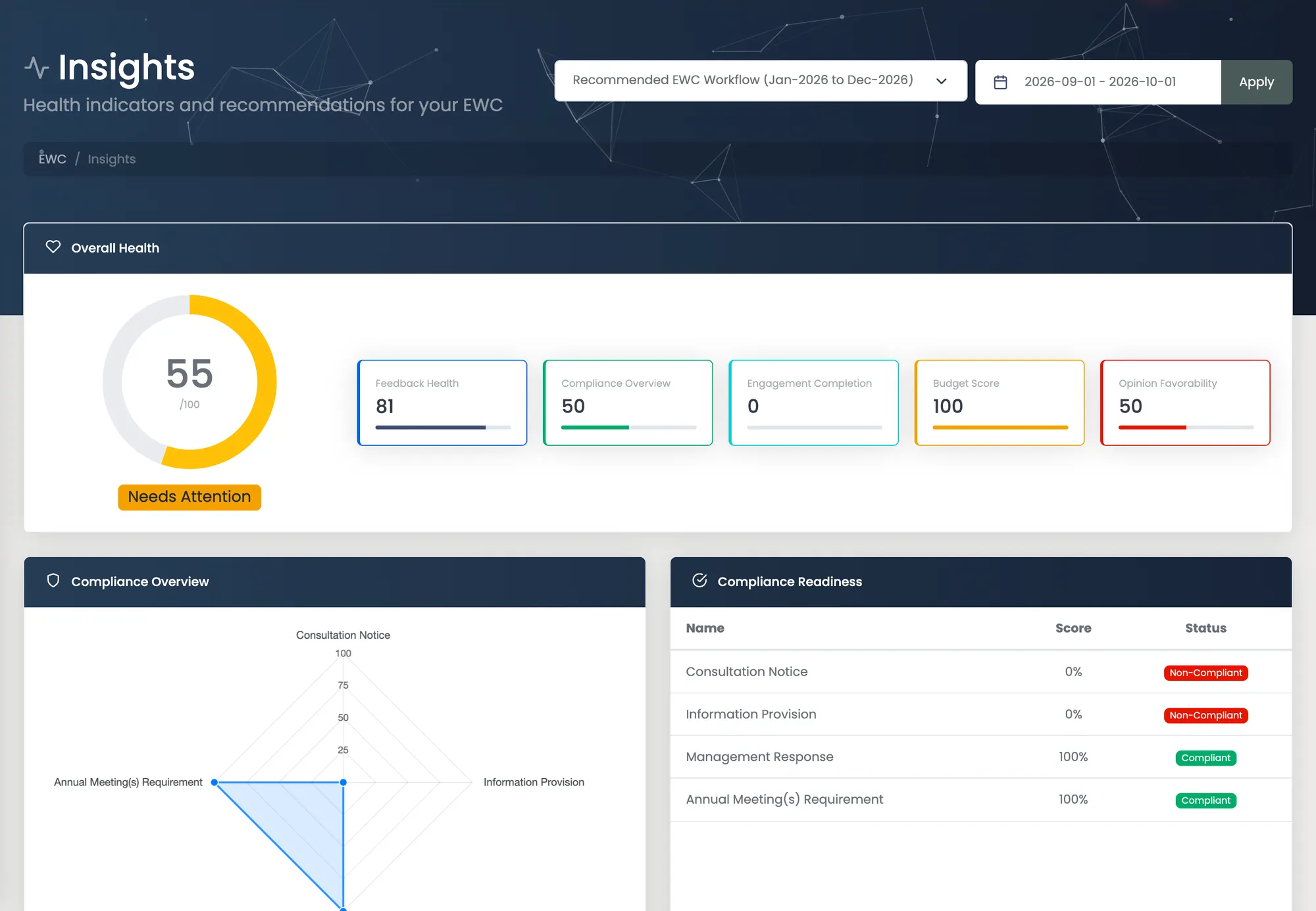
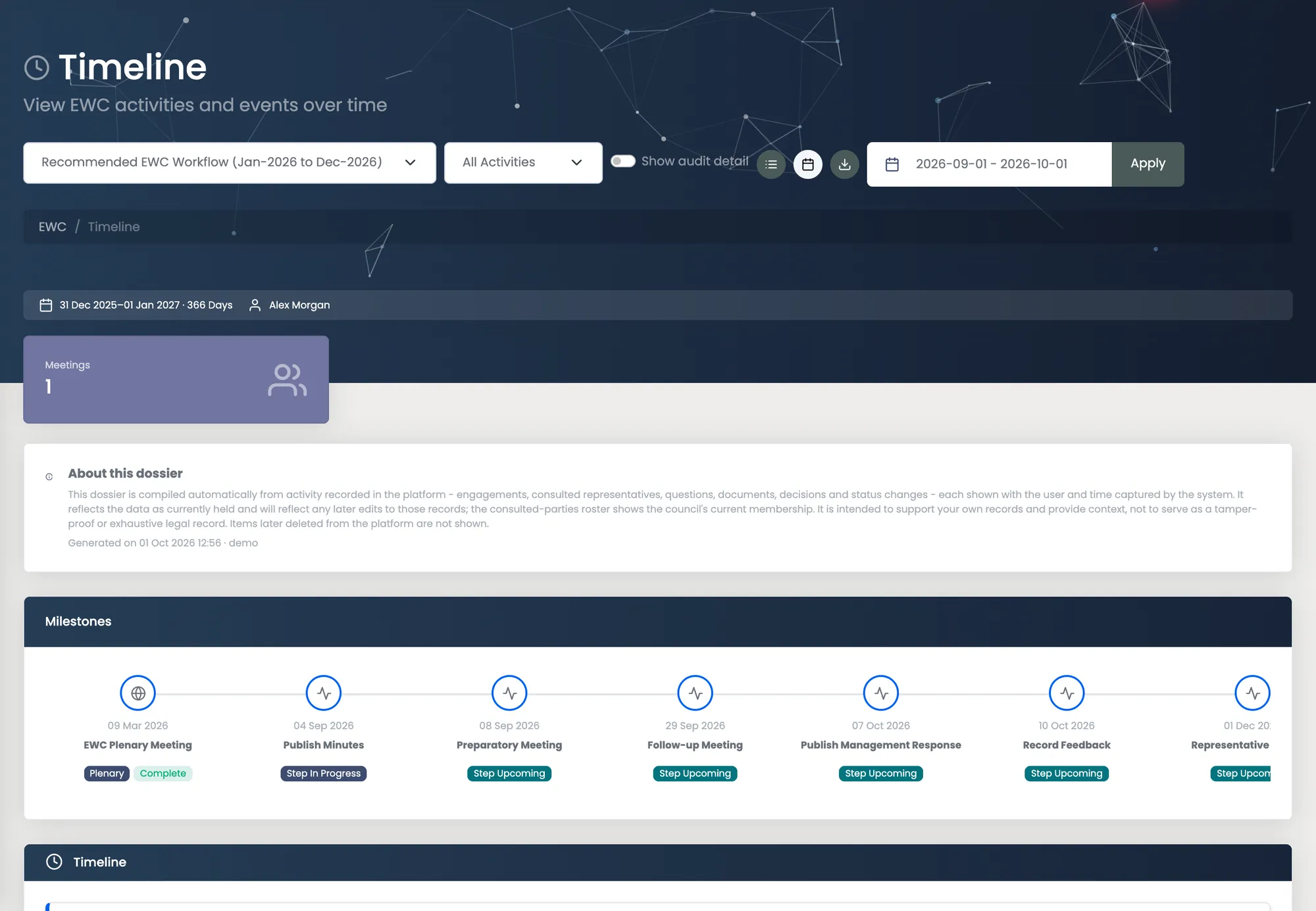
Graylark LRM is European Works Council software built for exactly this: agreements, meetings, information and consultation workflows, opinions and reasoned responses, and timeline evidence, in one multilingual platform. Book a demo to see what recast-ready looks like.
See it in Graylark.
Built for scrutiny.
Certified and tested
Cyber Essentials certified at Whole Organisation scope, and an independent penetration test of the platform in 2026.
Data inside the EEA
Stored and processed within the European Economic Area, with a dedicated database for each customer.
AI that stays inside
Inference inside Graylark’s EEA environment, no external AI APIs in the customer-data path, and no training on customer data.
Ready for procurement
The security pack, the Data Processing Agreement and the penetration test report are standing documents, sent the same day your security team asks.