
The Slowest Country Decides: Measuring How Long Business Change Really Takes
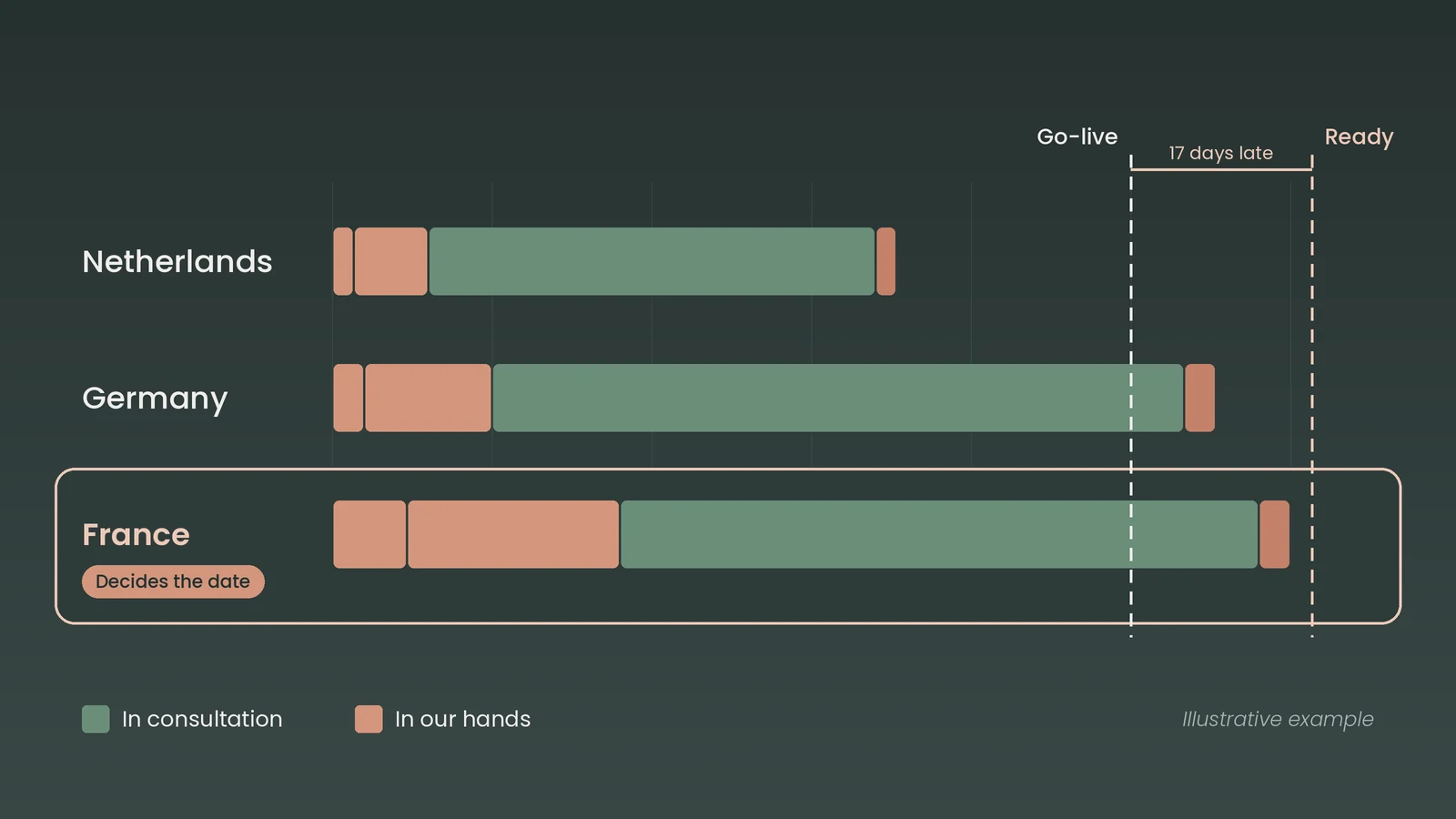
The business wants the change live on the first of March. Employee Relations hears about it in the second week of January. Somewhere in between, three countries, three employee representative bodies and their legal clocks have to fit.
Anyone who has worked in multinational Employee Relations knows how this story usually ends: a late scramble, a go-live that slips, and a relationship with representatives that is a little more strained than it was before.
In an earlier article we looked at why global restructurings take longer than planned: the programme timeline and the consultation timeline were never the same thing. This article is about the next question: how long does business change, and works council consultation in particular, really take across countries, and how do you measure where the time goes?
You can't improve what you don't measure
Most ER teams can tell you, roughly, how long their last few changes took. Very few can tell you why. Was it the Betriebsrat in Germany? The fact that France only heard about the change three weeks after it was approved? The wait for the next scheduled meeting in the Netherlands? Or the fortnight it took for anyone to tell head office that a country was ready?
Without that breakdown, every conversation about "speeding up consultation" points at the most visible party, the employee representative body (ERB). That is usually the wrong target, and it is a damaging one. Representatives notice when a company starts treating their legal role as a delay.
So the starting point is a different goal. Not faster ERBs. Predictable change: knowing on day one whether the business's date is realistic, seeing while a change runs which country will decide the date, and learning afterwards where your own process could have started earlier.
The timeline of a change across countries
Every multinational change passes through the same milestones, and each one leaves a date behind if you have a system that records it:
- ER hears of the change. Ideally through a formal request from the business, not a corridor conversation.
- The change is prepared and sent to each country affected.
- Each country receives it, and picks it up. Receiving and acting are not the same thing.
- Each ERB is engaged, and later finishes: an opinion given, a negotiation concluded, consent granted.
- Each country is ready to implement.
- The change is ready, and the business is told.
Put dates on those milestones and the time between them falls into a small number of legs. For each one, ask a simple question: in whose hands is this time?
- Gateway to change (ER): from the business's request to ER creating the change.
- Preparing the change (ER): from the change being created to it reaching the first country.
- Added later (ER): from the first country receiving the change to the deciding country receiving it, when that country was added late.
- Not picked up yet (country HR): from a country receiving the change to it first acting on it.
- Country preparing (country HR): from the country acting to an ERB being engaged; usually local advice, the information for the ERB and a meeting date.
- In consultation (both sides): while at least one ERB is engaged. The representatives deliberate, and the employer answers their questions and supplies information throughout.
- Between ERBs (country HR): from one ERB finishing to the next being engaged.
- Country sign-off (country HR): from the last ERB finishing to the country being ready.
- ER closing (ER): from the last country being ready to the change being ready.
Only one of those legs is shared with the representatives: the consultation itself. Every other leg is in the company's own hands. That does not make it waste: much of it is necessary work, such as taking local advice and preparing the information an ERB must receive. But it is time the company controls, and can start earlier.
Why the slowest country decides the date
Here is the most important thing about multinational change, and the reason most efficiency metrics mislead: when a change goes live as one programme, it is ready only when its slowest country is.
Not every change works that way. Where the decisions are genuinely separable and each country's obligations have been met, a change can be phased, with each country going live on its own date, subject to the dependencies between them. Many changes cannot be separated, though, and for those the slowest country sets the date for everyone.
Averages hide this. If you average "time to engage the ERB" across every country, the quick countries flatter the figure, and the country that actually held up the change disappears into the mean. Four averaged numbers that don't add up to anything tell you very little.
The honest way to read a change is along the path of the country that decided the date. Take an illustrative example, with simplified day counts: a customer service consolidation across France, Germany and the Netherlands, going live as one programme. The business asks for go-live 90 days after ER first hears of it.
- The request reaches ER on day 0. ER creates the change on day 6 and sends it to all three countries on day 15.
- The Netherlands picks it up on day 17 and asks the ondernemingsraad for its advice on day 24. The advice comes on day 66, and because the decision follows it, there is no one-month suspension. The country is ready on day 68.
- Germany picks it up on day 18 and informs the Betriebsrat on day 30. Negotiations on the Interessenausgleich end on day 95, and Germany is ready to implement on day 98.
- France picks it up on day 22. Local HR takes advice, prepares the information document and puts the change to the CSE at its next monthly meeting, on day 42. The CSE appoints an expert, so the law gives it two months, and it gives its opinion on day 102. France is ready on day 105.
- The change is ready on day 107, 17 days after the date the business asked for.
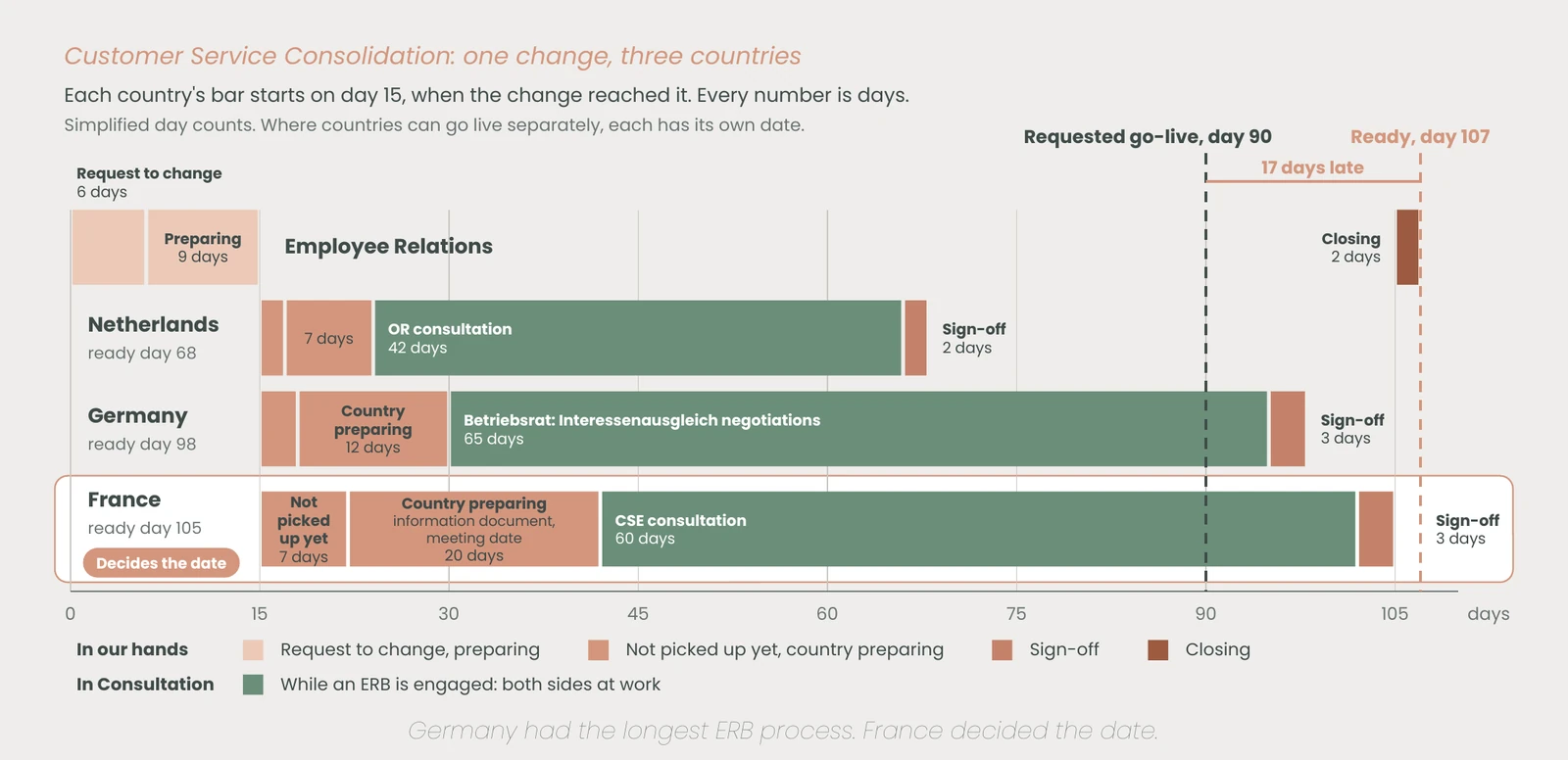
Germany had the longest consultation, at 65 days. But France decided the date. Of France's 107 days, 60 were in consultation with the CSE: the two months the default framework allows when the CSE appoints an expert. The other 47, 44% of the total, were in the company's own hands:
- 6 days from the request to the change;
- 9 days preparing it;
- 7 days before France picked it up;
- 20 days taking advice, preparing the information document and reaching the next CSE meeting;
- 3 days between the CSE's opinion and France signing off;
- 2 days closing.
That is the picture that changes behaviour. The CSE's two months are a planning boundary, not a target for shortening the representatives' deliberations: the priority is complete information, given early, and a consultation that means something. What the company controlled was when France reached its CSE: twelve days after Germany reached its Betriebsrat. Starting the information document while ER was still preparing the change, and asking for an extraordinary CSE meeting rather than waiting for the monthly one, is where the date is won or lost.
Two kinds of time, and the legal framework
Separating "in our hands" from "in consultation" is the single most useful thing a metric can do in this space. The first is the time you can shorten, mostly by starting earlier and working in parallel. The second is the time to plan for: both sides work in it, and its length belongs to the process, not to one party.
The law frames the consultation, usually with an outer limit rather than a minimum. In France, under the default framework, the CSE gives its opinion within one month of being informed, or two months when it appoints an expert. It can give it sooner, an agreement with the representatives can set other periods, and if it has given none when the period ends, it is deemed to have given a negative opinion. In Spain, the comité de empresa has up to 15 days to give its report. These periods are a planning boundary, and a consultation that runs to them is not a delay. Show the period beside the consultation, so everyone can see the framework the time was spent in.
What happens when the change also involves an EWC?
Many multinational changes are also transnational: they affect employees in two or more countries in a way that brings in the European Works Council. That adds a workstream of its own, with its own timeline: informing the EWC, its opinion where it is consulted, and management's response.
It is not simply another country in the race. How the transnational and national processes fit together, and in what order, depends on the EWC agreement and on national law, and both aim at the same thing: representatives must be able to influence the decision while it can still change. In some organisations the EWC is consulted before the national bodies; in others the processes run in parallel. The revised EWC Directive strengthens what timely consultation means.
For the metrics, treat the EWC as a lane of its own, with its own legs, and read the change along whichever lane decides the date. When the EWC process has to come first, its lane can set the timetable for every country after it.
Five employee relations metrics worth tracking
With the timeline in place, five metrics tell an ER leader most of what they need to know:
- Time to ready. The median number of days from ER hearing of a change to it being ready to implement: the typical case. For planning, use a more cautious figure, such as the date three in four similar changes were ready by (the 75th percentile), once you have enough of them.
- In our hands. The share of that time spent outside consultation, before and after it. This is the part you can shorten, usually by starting earlier.
- Ready by go-live. The share of changes that were ready by the first go-live date the business gave. This is the outcome the business sees. It has to be the first date, or moving the go-live later makes a late change look on time.
- Notice given. The median number of days between ER hearing of a change and its go-live. Put it next to time to ready and you have the argument for involving ER earlier, made with your own numbers rather than an industry survey.
- Countries that decide the date. How often each country was the slowest, and how long those changes took. This is where to plan earlier, or where to consider splitting a roll-out so that one long-tail country does not hold back the rest.
Three rules keep those numbers honest. Prefer medians for typical durations: durations are skewed, most organisations run tens of significant changes a year, and one long French or German procedure would swamp an average. Look at the spread too, not just the middle. Always say how many changes a figure rests on, and below about five, show nothing at all rather than a number that means nothing. And never count a planned meeting date as time already spent.
From looking back to looking forward
Measuring past changes explains. Forecasting the next one changes behaviour.
Once you know how long each country typically takes for each kind of change, you can answer the business's question on the day it is asked. For each country a change touches, take the best evidence available, in this order:
- Your own history: for that country and that type of change, once you have enough of them. The median gives the typical case; the 75th percentile gives the date to plan for.
- The national rule: the outer limit of the legal framework, where one is known.
- Your own policy: the time limit your ER team works to.
The latest country's date is the change's expected ready date. Give the business two dates: when the change is typically ready, and the later date to plan for. If it falls after the go-live the business has asked for, say so on day one, but only when the estimate rests on history or law. An internal time limit is a policy, not a prediction, and an alarm built on it will be ignored within a month.
A new team will start with little history, and its forecasts will lean on national rules and its own limits until it has finished enough changes. That is worth saying out loud rather than hiding.
What not to measure
There are two tempting metrics we would argue against.
The first is a league table of ERBs: which representative body is "slowest". It measures the wrong party, it invites exactly the wrong conversations, and representatives will find out it exists.
The second is a single cross-company "ER efficiency score". It is attractive on a slide, but it mixes very different things into one number that nobody can explain, and comparing companies means pooling their data, which most will rightly refuse. Your own numbers, measured consistently and looked at over time, are worth more than a benchmark you cannot interrogate.
How long does works council consultation take? Common questions
How long does CSE consultation take in France?
For most projects, the CSE has one month from receiving the information to give its opinion, two months when it appoints an expert, and three months when an expert is involved and both the central and the establishment CSEs are consulted (article R.2312-6 of the Code du travail). If it gives no opinion in time, it is deemed to have given a negative one. A collective redundancy with a job-saving plan (PSE) runs longer: two, three or four months depending on the number of dismissals (article L.1233-30). Our guide to restructuring in France covers the CSE and the PSE in more detail.
How long does an Interessenausgleich take in Germany?
The law sets no fixed period. Before an operational change (section 111 BetrVG), the employer must genuinely try to reach a reconciliation of interests with the Betriebsrat (section 112), through an Einigungsstelle if necessary. Agreement cannot be compelled: the negotiations ending, an agreement being reached and the employer being legally ready to implement are three different things. A social plan for the economic consequences is a separate matter. In practice, several months is common. See restructuring with a German works council.
Can a Dutch company act straight after the ondernemingsraad gives its advice?
Only if the decision follows the advice. If it departs from it, the company must wait one month before implementing, during which the ondernemingsraad can appeal to the Enterprise Chamber (article 25 of the Works Councils Act). Planning should allow for that month whenever agreement is uncertain.
How long does consultation take in Spain?
The comité de empresa gives its report, an opinion rather than a negotiation, within at most 15 days of being asked and sent the information (article 64 of the Estatuto de los Trabajadores). A collective dismissal has its own consultation period of up to 30 days, or 15 days in a company with fewer than 50 employees (article 51).
What should Employee Relations measure?
Time to ready along the slowest country (the median, with the 75th percentile for planning), the share of that time in the company's own hands, whether changes are ready by the first go-live given, the notice Employee Relations receives, and which countries most often decide the date. Track them as medians over your own finished changes, and keep them alongside the engagement measures in why you should track employee representative engagement.
For running consultation across several countries at once, see cross-border restructuring consultation and workforce change consultation.
How Graylark measures this
We built these metrics into Change Proposals in the Graylark Platform. When change requests arrive through the Change Gateway, the clock starts the moment the business first tells ER. Every change shows its lead time and the country deciding the date and, while it runs, when it is typically expected to be ready and the date to plan for. The Consultation Dashboard tracks the five numbers over time. And the person in the business who raised the change sees how many countries are ready and when the change is expected, without ever seeing what any representative body said.
The aim is simple: know on day one, track the country that decides, and start earlier on the time that is ours.